
tier1 – Carbon Reduction Plan
Supplier name: Tier 1 Asset Management
Publication date: 22 October 2026
Introduction
Tier 1 Asset Management is committed to achieving Net Zero greenhouse gas (GHG) emissions.
As a leading IT Asset Disposal (ITAD) company, Tier 1 actively drives the circular economy through its BSI Kitemarked remanufacturing process and environmentally conscious recycling of end-of-life IT equipment, thereby reducing the demand for new products and associated emissions. Supporting the avoidance of new carbon generation by extending IT lifespan and ensuring its proper use through downstream processing.
Baseline Emissions Footprint
The baseline emissions inventory for FY2022 includes Scope 1, Scope 2, and selected Scope 3 categories (1 – Purchased goods and services, 3 – fuel and energy related activities, 4 – Upstream transportation and distribution, 5 – Waste generated in operations, 6 – Business travel).
This is in accordance with the GHG Protocol and UK Government Carbon Reduction Plan guidance.
Baseline and recent data are as follows:
| Emissions | Baseline 2022 tCO₂e | FY 24-25 tCO₂e | CY 25 tCO₂e |
| Scope 1 | 165.5 | 76.9 | 84.5 |
| Scope 2 location based | 69.4 | 185.4 | 39.6 |
| Scope 2 market based | 0.0 | ||
| Scope 3 (cat: 1,3,4,5,6) | 565.8 | 496.19 | 2558.5 |
| Total | 800.7 | 758.5 | 2682.6 |
Additional tCO₂e emissions generated (not baselined in 2022)
Employee commuting:
- 24/25 – 30.3 tCO₂e (based on data covering 2 months only)
- Calendar 2025 – 55.9 tCO₂e
Downstream transportation and distribution:
- 24/25 data: 865.2 tCO₂e
- Calendar 2025: This is included now in scope 3 emissions as total logistics.
As a graph this data can be represented as such:
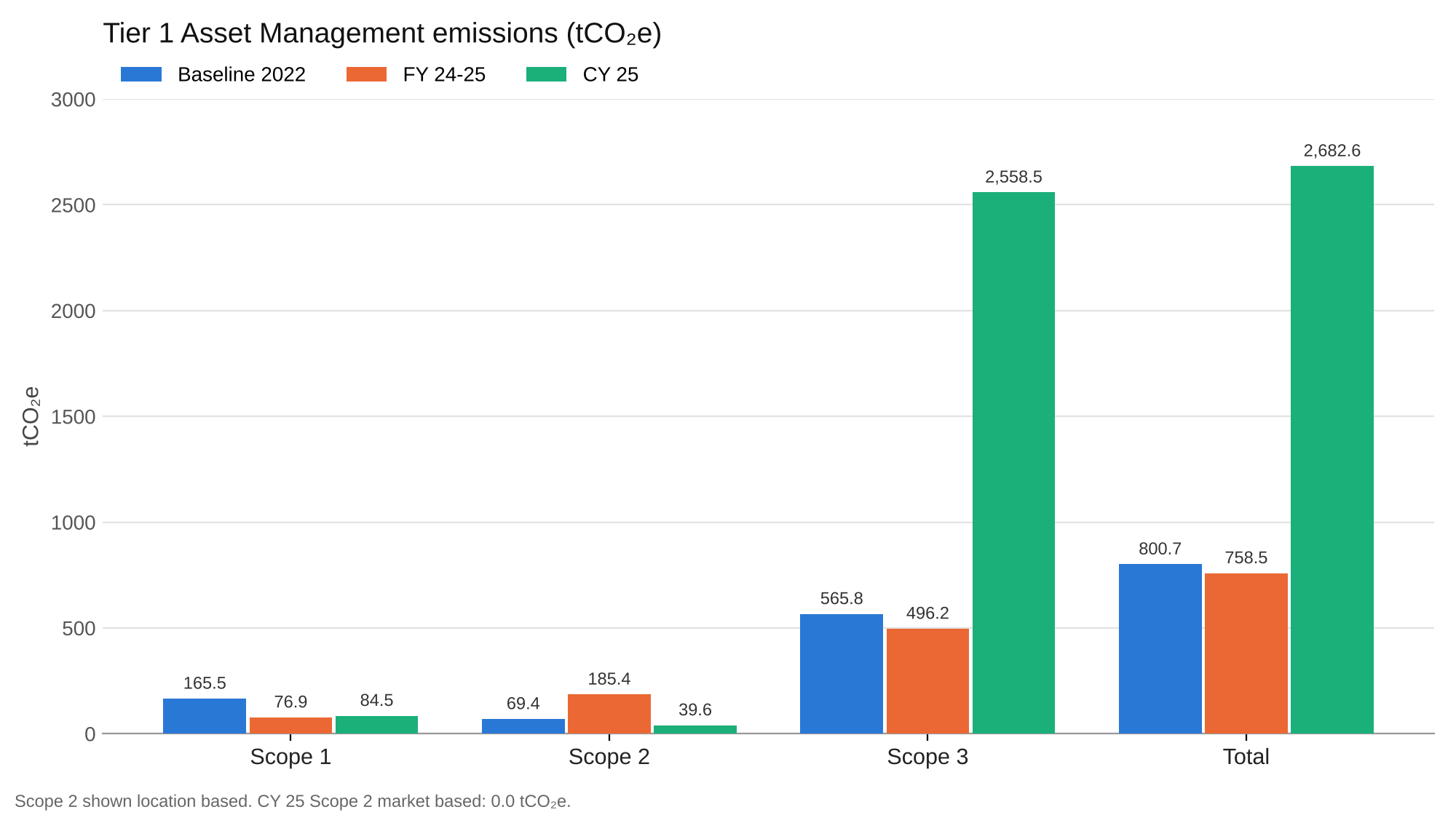
The increase in Scope 3 emissions is in connection with the increased demand in secure logistics collections that take small quantities of items direct to our sites with no other products in the van, coupled with the use of Greenly system which aligns to the GHG protocol meaning all our procured stock that we buy in for remanufacture is now categorised as scope 3.1 where prior it was incorrectly categorised as out of scope means the increase is present.
Emissions Reduction Targets
Previous year emissions targets set were as follows:
- 2025: 10% reduction in Scope 1 and 2 emissions from baseline
- 2030: 50% reduction across all scopes
- 2035: 75% reduction across all scopes
- 2040: Net Zero emissions
These are now in review in conjunction with our SBTi goal for Net Zero by 2050 and the use of Greenly helping us to gather finer detail in line with the GHG protocol.
Tier 1 is still committed to achieving Net Zero by 2050 but is now reviewing the most direct and efficient way to deliver this change while also improving the circular economy.
Planned Carbon Reduction Measures
Note these are also in review.
In addition to the planned emission reduction targets Tier 1 will investigate and review the impact of the following activities:
- Expand Scope 3 activities to include the following categories:
- 2 – Capital goods,
- 7 – Employee commuting,
- 9 – Downstream transportation and distribution,
- 11 – Use of sold products,
- 12 – End-of-life treatment of sold products.
- Implementation of a GHG Protocol-aligned carbon data platform and reporting
- Quantification and reporting on avoided emissions from circular economy practices.
- Identify residual emissions that cannot be eliminated and offset appropriately.
Offsetting Strategy
Tier 1 will look to use as appropriate high-quality, UK Government-approved carbon offsets such as those certified under the Woodland Carbon Code.
Verification and Reporting
Any Net Zero claims made by Tier 1 will be verified and validated by an ISO 14064 accredited 3rd party.
Reporting will be aligned to relevant principles to support activities of Tier 1, this includes GRI (Global Reporting Initiative), TCFD (Task Force on Climate-related Financial Disclosures), ISSB (International Sustainability Standards Board) and similar.
Progress will be reviewed internally and reported annually with this plan being reviewed every 5 years after 2025.
Standards and Framework Alignment
Tier 1 aligns itself to the following frameworks and standards in this process and looks to make sure that all tools utilised in support of this plan demonstrate similar commitment and alignment.
- GHG Protocol (Scopes 1, 2, and 3)
- UK Government Carbon Reduction Plan Template
- ISO 14001 Environmental Management System
- PAS 2060 Carbon Neutrality Standard
- UK PPN 006
Declaration and Sign Off
This Carbon Reduction Plan has been completed in accordance with PPN 006 and associated guidance and reporting standard for Carbon Reduction Plans.
Emissions have been reported and recorded in accordance with the published reporting standard for Carbon Reduction Plans and the GHG Reporting Protocol corporate standard[1] and uses the appropriate Government emission conversion factors for greenhouse gas company reporting[2].
Scope 1 and Scope 2 emissions have been reported in accordance with SECR requirements (where required), and the required subset of Scope 3 emissions have been reported in accordance with the published reporting standard for Carbon Reduction Plans and the Corporate Value Chain (Scope 3) Standard[3].
This Carbon Reduction Plan has been reviewed and signed off by the board of directors (or equivalent management body).
Signed on behalf of the Supplier:
Paul Shortland, Sustainability and Compliance Services Manager
Date: 22 October 2026
[1]https://ghgprotocol.org/corporate-standard
[2]https://www.gov.uk/government/collections/government-conversion-factors-for-company-reporting
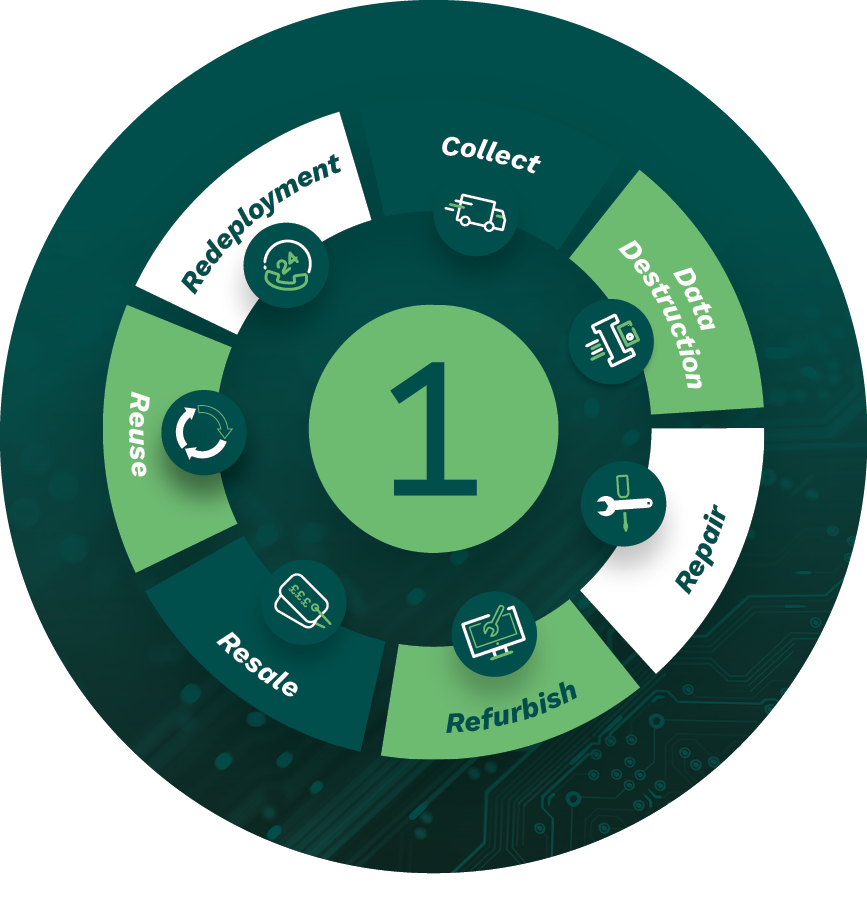
Reduce. Reuse. Redeploy. Recycle
Circular Approach to Sustainability
We ensure that the Lifecycle Services we provide are sustainable and circular in approach, and actively promote the reuse of all equipment where possible. We work closely with our clients to improve awareness of environmentally favourable solutions, ensuring recycling is the last option considered and making a real contribution to your ESG goals.